Key Takeaways
- Unprecedented Speed: Tasks that once took weeks, such as full-scale product photography shoots or writing hundreds of product descriptions, can now be completed in minutes.
- Cost Efficiency: AI significantly reduces overhead costs by minimizing the need for expensive agencies, professional studios, or large support teams.
- Enhanced Conversions: High-quality, AI-generated visuals and hyper-personalized copy directly correlate with higher click-through and conversion rates.
- Scalability: AI tools grow with your business, allowing you to easily handle seasonal spikes without scrambling for additional resources.
In the fast-paced and hyper-competitive digital marketplace of 2026, relying solely on traditional methods for running an online store is no longer enough. The shift from manual, time-consuming processes to streamlined, AI-driven workflows has completely revolutionized how we approach online retail. At the forefront of this digital renaissance are ai ecommerce tools, which have evolved from novelty additions to absolute necessities for any serious Shopify or Amazon seller.
Whether you are struggling to produce high-quality product imagery at scale, spending countless hours writing engaging product descriptions, or trying to manage an overwhelming influx of customer support tickets, AI has a solution. This comprehensive guide will explore the top AI ecommerce tools available today, with a special focus on how you can dramatically transform your product visuals and, ultimately, boost your sales and conversion rates.
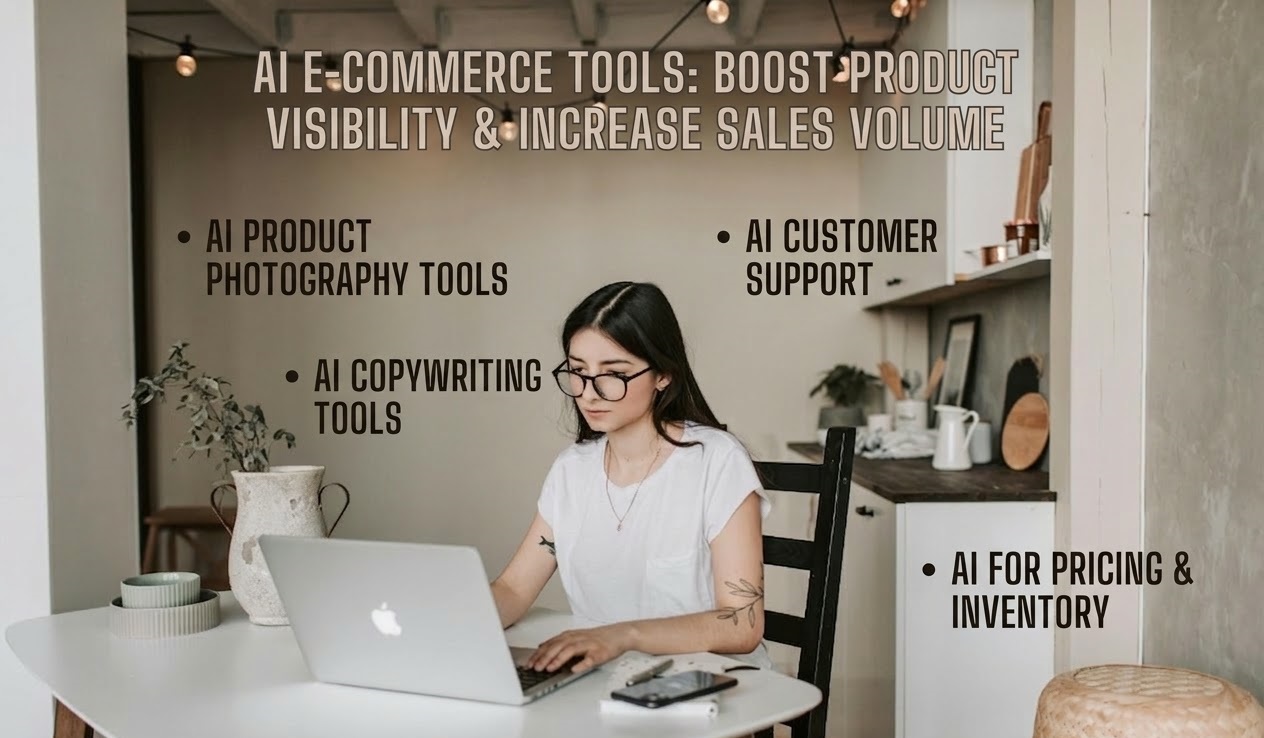
The Power of AI Ecommerce Tools: Why Sellers Are Switching Now
The transition to artificial intelligence in ecommerce is not just a trend; it is a fundamental shift in business operations. The modern consumer demands personalization, rapid response times, and visually stunning storefronts. Meeting these demands manually requires an immense amount of time, capital, and human resources. AI ecommerce tools bridge this gap by automating complex tasks and delivering professional-grade results at a fraction of the cost.
To understand the sheer impact of these technologies, let's look at a quick comparison between traditional workflows and modern AI-powered strategies:
Quick Facts: Traditional vs. AI-Powered Workflows
| Business Area | Traditional Workflow | AI-Powered Workflow | Impact |
|---|---|---|---|
| Product Photography | Expensive studios, physical props, days of editing. | Instant background generation, virtual staging, realistic lighting. | Cost reduced by 90%, output increased by 10x. |
| Copywriting | Hiring freelancers, manual keyword research, slow turnaround. | Automated generation, SEO-optimized, instant variations. | Hours saved, consistent brand voice across all SKUs. |
| Customer Support | Manual ticketing, long wait times, limited operating hours. | 24/7 intelligent chatbots, instant resolution, automated routing. | 95% faster response times, improved customer satisfaction. |
The Top Tools Category by Category
Navigating the vast ocean of AI software can be daunting. To make it easier, we have categorized the most impactful AI ecommerce tools into three critical areas: Visuals, Copywriting, and Customer Support.
1. Visuals and Product Photography
In ecommerce, your product photos are your digital storefront window. They are the single most important factor in a customer's purchasing decision.
LumaBox AI
When it comes to revolutionizing product photography, LumaBox AI stands entirely in a league of its own. Designed specifically for ecommerce sellers, LumaBox AI eliminates the need for expensive photoshoots. By simply uploading a basic photo of your product, the AI instantly removes the background and generates breathtaking, highly realistic lifestyle scenes. Whether you need sleek, minimalist backgrounds for Amazon or vibrant, context-rich scenes for social media, LumaBox AI handles it all. For sellers in niche markets, such as jewelry, finding the perfect backdrop is notoriously difficult. LumaBox AI effortlessly creates stunning jewelry photography backgrounds that highlight the intricate details and shine of your products.


Photoroom
Photoroom remains a solid choice for quick background removal and basic template applications. It is particularly useful for sellers who need to rapidly standardize their product catalog with pure white backgrounds for marketplace compliance. While it may lack the advanced, hyper-realistic lighting physics of LumaBox AI, it is a highly capable tool for rapid, high-volume batch processing.
Midjourney (for Ideation)
While not a dedicated ecommerce tool, Midjourney is an incredible asset for mood boarding and conceptualizing marketing campaigns. Brand managers can use it to generate highly stylized background concepts or aesthetic directions, which can then be used as inspiration for their actual product shoots.
2. Copywriting and SEO Optimization
Writing compelling product descriptions that satisfy both search engines and human readers is an art form. Fortunately, AI has mastered it.
Jasper AI
Jasper AI is a powerhouse for generating marketing copy. It excels at writing engaging product descriptions, ad copy, and email newsletters. By inputting a few key features of your product, Jasper can generate multiple variations of persuasive text, allowing you to A/B test and find the highest converting description.
ChatGPT (OpenAI)
The versatility of ChatGPT makes it an indispensable tool for ecommerce business owners. From brainstorming product names to writing detailed blog posts (like the one you are reading right now!), ChatGPT can be trained on your specific brand voice to produce highly customized and scalable written content. It is also excellent for bulk-generating meta titles and descriptions for massive product catalogs.
Frase.io
For sellers heavily focused on organic traffic, Frase.io is an exceptional AI tool. It analyzes search intent and helps you optimize your product pages and blog content to rank higher on search engines. It ensures that your copy includes the right semantic clusters and answers the exact questions your potential customers are asking.

3. Customer Support and Personalization
Providing exceptional customer service is crucial for retention and building brand loyalty.
Gorgias
Gorgias is an ecommerce-specific helpdesk that integrates deeply with platforms like Shopify and Magento. Its AI capabilities allow it to automatically categorize tickets, detect customer intent (e.g., asking for a refund or tracking an order), and even respond to common queries instantly without human intervention.
Klevu
Klevu utilizes advanced natural language processing (NLP) to revolutionize on-site search. When a customer types a query into your store's search bar, Klevu's AI understands the intent behind the words—even if they are misspelled—and delivers highly relevant product recommendations, significantly boosting average order value (AOV).

Deep Dive into LumaBox AI: The Future of Product Visuals
While all the tools mentioned above provide significant value, the most dramatic return on investment usually comes from upgrading your visual content. LumaBox AI is not just another background remover; it is a comprehensive, generative AI studio built for the modern merchant.
Hyper-Realistic Virtual Staging
Traditional lifestyle photography requires renting locations, hiring models, and purchasing props. LumaBox AI replaces all of this with intuitive text prompts and smart templates. You can place a bottle of sunscreen on a sun-drenched beach in Bali or a luxury watch on a sleek, rain-slicked city street, all within seconds. If you want to master this art, our guide on lifestyle product photography offers deep insights into creating scenes that sell.
Intelligent Lighting and Shadow Fusion
One of the biggest giveaways of poorly edited AI photos is mismatched lighting. LumaBox AI solves this through proprietary algorithms that analyze the original lighting of your product and seamlessly blend it with the generated environment. The AI dynamically generates realistic drop shadows, reflections, and ambient light. Even if your original source image was shot in a dim room, LumaBox AI can salvage it. Learn more about how you can fix bad lighting with AI to ensure your products always look their best.
Professional-Grade Output and Editing
Beyond generative backgrounds, LumaBox AI offers a suite of tools designed to refine your images to perfection. From upscaling resolution for massive print campaigns to fine-tuning color balance for color accuracy, the platform gives you agency-level control. For a comprehensive look at maximizing these features, explore our professional product photo editing guide.

How to Choose the Right Tool: A Quick Guide
With so many powerful ai ecommerce tools on the market, how do you decide where to invest your time and budget? Follow this simple framework:
- Identify Your Biggest Bottleneck: Are you struggling with low conversion rates? It's likely a visual problem. Are you overwhelmed by customer emails? Focus on an AI helpdesk. Target the area that will provide the most immediate relief and ROI.
- Evaluate Integration: Ensure the tool integrates seamlessly with your existing tech stack. If you use Shopify, look for apps that plug directly into your dashboard.
- Assess the Learning Curve: The best AI tools are intuitive. If a platform requires weeks of training to use effectively, it defeats the purpose of AI-driven efficiency. Look for solutions with user-friendly interfaces, like LumaBox AI.
- Consider Scalability: Choose tools that offer flexible pricing and can handle increased volume during peak seasons like Black Friday and Cyber Monday.
Conclusion & Call to Action
The year 2026 has firmly established that AI is no longer optional for ecommerce success; it is the baseline. By strategically integrating the right ai ecommerce tools into your workflow, you can drastically reduce operational costs, save hundreds of hours, and create shopping experiences that deeply resonate with your target audience.
From automating your customer service with intelligent chatbots to generating persuasive, SEO-optimized copy, the possibilities are endless. However, in a digital space where the visual reigns supreme, your product imagery remains your most powerful asset.
Don't let subpar photos hold back your sales potential. Experience the future of commercial photography today. Transform your raw, unedited product shots into breathtaking lifestyle masterpieces in seconds.
Ready to elevate your brand and boost your conversions? Try LumaBox.ai today and discover how effortless professional product photography can be.